Checked September 1, 2026

Lovable vs Replit

Two prompt boxes, one promise: type a sentence, get an app. Both keep it. What you’re picking is everything around the app once it exists. So on September 1, 2026 we gave both the same brief. A tool-lending app: a catalog, a request form, a database, a lender desk. Then we published what came out. Both apps are live below. What splits them is the computer underneath, the meter and how you get your code out.

See the finished apps first ↓

Lovable
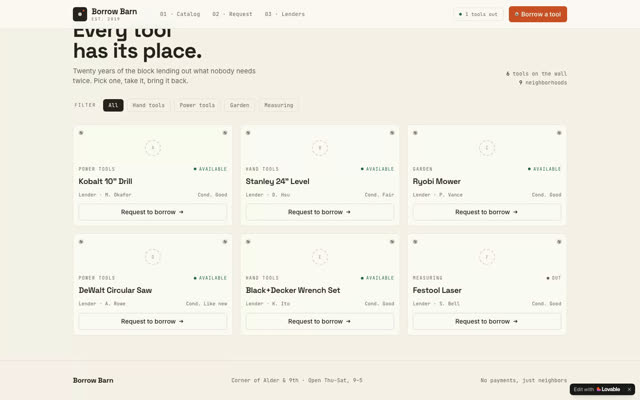
  1. 00:05 the catalog, live at its lovable.app URL

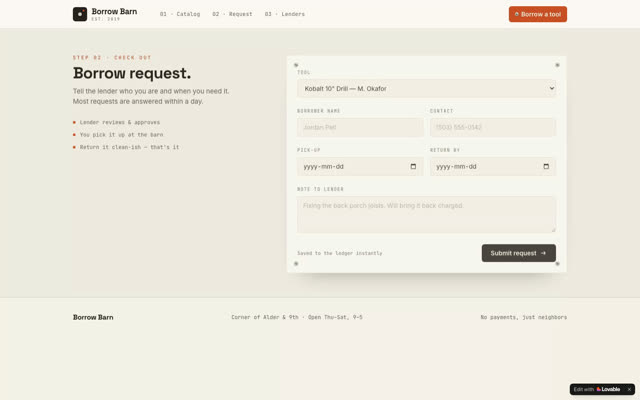
  2. 00:08 Request to borrow. The form, tool pre-picked

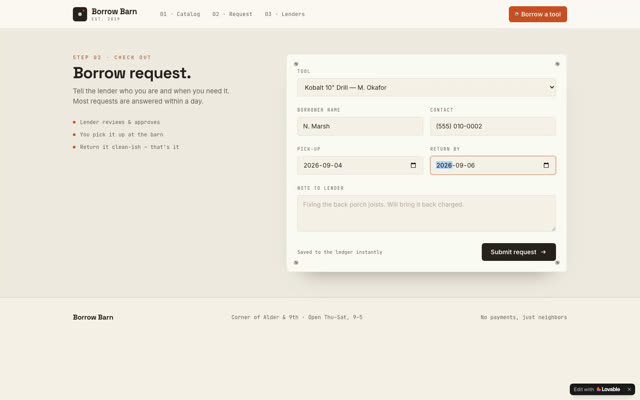
  3. 00:11 the borrower’s details, typed

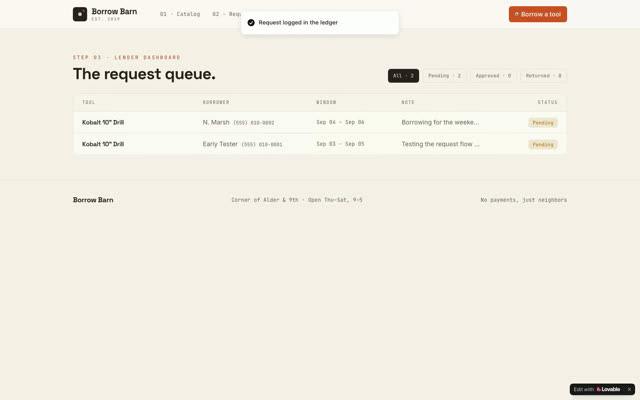
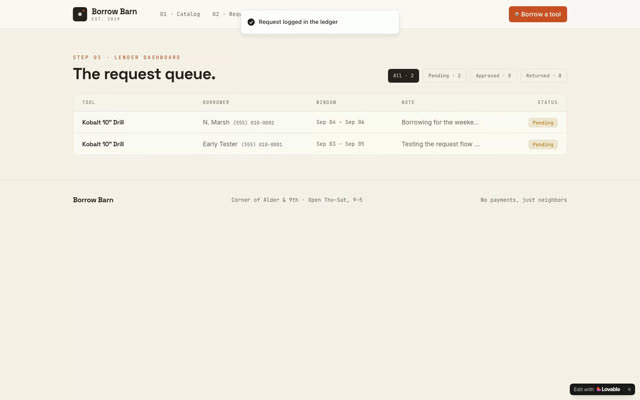
  4. 00:14 submitted. “Request logged in the ledger”

  5. 00:17 the queue, one row longer

Replit
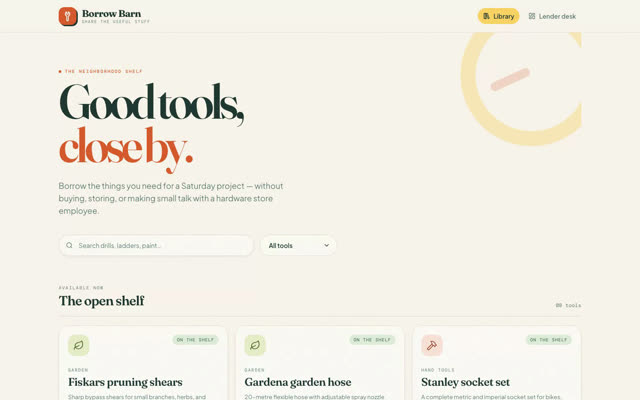
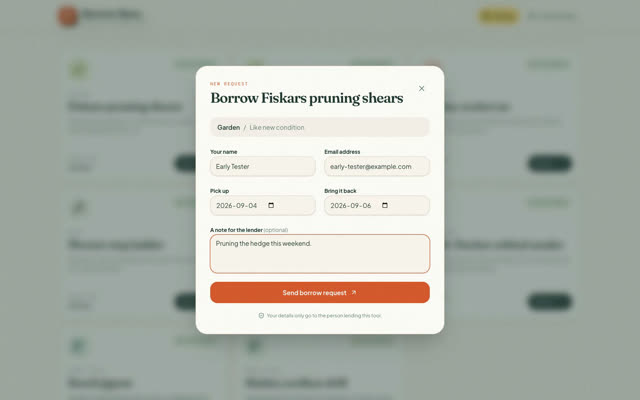
  1. 00:02 “Good tools, close by.” Live at its replit.app URL

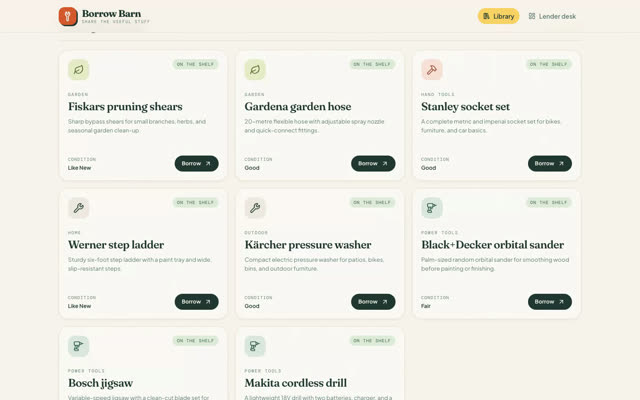
  2. 00:05 the shelf, eight tools it seeded itself

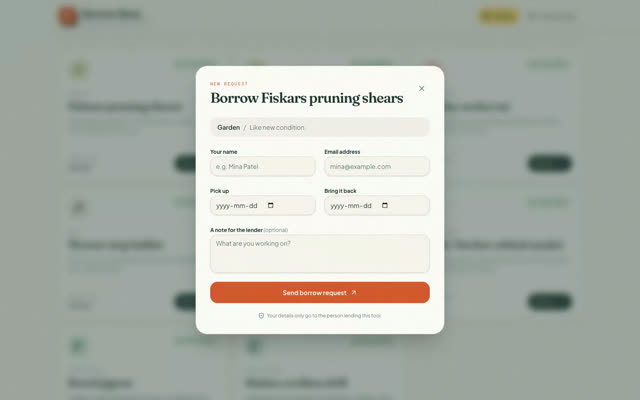
  3. 00:07 Borrow. The request form opens

  4. 00:12 the borrower’s details, typed

  5. 00:17 “You’re on the list.”

Lovable sells the finished app. Replit sells the computer it’s built on.

Pick Lovable when…

You want the app, and you’d rather never meet a terminal

  • Lovable manages the whole path: describe it, pick a design, publish. Our September 1 build asked one question, which design, then shipped a working catalog, form and dashboard to a free lovable.app URL.
  • One meter, one number: $25 buys 100 credits a month, and building, hosting and your app’s AI features draw on the same pool. There is no rate card to read.
  • The free tier publishes: five build credits a day, the published app stays up, and the deep security scan is free on every plan.
  • The code still leaves: GitHub sync on every plan, and self-hosting without restriction is stated in its docs.
Try Lovable free →
Pick Replit when…

You’ll want the machine underneath before the month is out

  • A real computer comes with it: a shell in every workspace, any language through Nix, and imports: GitHub, a zip, even a Lovable project.
  • Replit packages for the app stores: it generates native output through Expo and guides you through the submission. Lovable states it has no built-in path.
  • Replit prints its prices: Autoscale hosting from $2/mo plus metered compute, Reserved VMs from $15. Our whole September 1 build metered $1.06 of agent usage on the $20 Core plan.
  • The agent goes further on its own: it browser-tests what it builds, runs unattended for long stretches, and its paid modes carry a model picker.
Try Replit free →

Which one fits the way you’ll build?

1What are you building?
2What are you starting from?
3How much of the code will you work in yourself?
4What does it need to run?
5How should the bill behave?

What each pitch leaves out: Lovable’s fixed stack, and Replit’s bill.

Lovable

An AI app builder with one way of working: describe the app and it builds a full-stack web app on its managed backend, published in two clicks. The code syncs out to GitHub on every plan.

Sold as: idea to app, no code and no setup Built for: people who want the app, not the machine under it
What the pitch leaves out

Lovable makes those choices for you. Its own comparison guides say it plainly: no IDE, no terminal, no importing an existing codebase. The stack is Lovable’s to choose, a React web app on Lovable Cloud.

Fine if you're starting fresh and building the kind of web app Lovable makes. If your project already exists, Lovable won't import it, and if it was never a web app it won't build it.

What comes built in
The backend: a database, sign-in for your app's users, file storage, serverless functions and hosting, metered by one credit pool. Payments through Stripe or Paddle from the Pro plan up. A security scan that runs itself every time the publish dialog opens, with the deep version free on every plan. And analytics that start collecting the moment you publish.
What you connect yourself
Email through Resend and SMS through Twilio, on accounts you bring. GitHub for the code: export first, then two-way sync. Your own Supabase if you'd rather not use Lovable Cloud. And 96 one-click connectors for the rest. The connectors themselves cost no credits.

Replit

A full cloud development environment with an agent on top. It builds the app, and underneath there's a real computer: a shell, any language, your existing repos, and hosting with a published rate card.

Sold as: the fastest way from idea to deployed software Built for: builders who'll eventually want the machine underneath
What the pitch leaves out

Replit charges by what you use. Agent work bills per effort-based checkpoint, hosting bills per compute unit, and the free plan’s one published app takes its link down after 30 days. What a build costs is knowable only once it’s built.

Fine if you'll watch the meter and stay on it. If you wanted one number a month, that's the plan Lovable sells.

What comes built in
The machine: a shell, a full editor free on every plan, PostgreSQL with 20GB storage per app, Git, and a runtime that takes any language through Nix. Agent 3's long unattended runs, browser testing of the app it built, and image generation. Four deployment types with prices printed on the page.
What you connect yourself
Most of the 450+ connector directory needs a Core plan or higher. The free tier keeps only Replit-managed pieces like the database and auth. Stripe payments need Core too. And end users sign into your app with Replit accounts unless you connect Clerk yourself.
What you’re actually buying

Both meter you monthly. Lovable sells a fixed number of credits, Replit bills what you use

Commercial signals for Lovable and Replit, from the scan of September 1, 2026.
Commercial signal lovable.dev replit.com
Same on both
Free tier
Self-serve signup
Billing cyclesMonthly & annual
Their own mobile appiOS & Android
Entry paid price $25/mo (Pro) $20/mo (Core, or $17/mo billed annually)
What the meter counts Credits per message, priced by task. Building, hosting & in-app AI share the pool Effort-based checkpoints for the agent, plus metered compute, requests & storage for hosting
What the free tier actually holds 5 build credits/day (30/mo cap) + 20 Cloud credits + 4 AI credits monthly. The code editor is read-only Daily agent credits to a monthly cap. 1 published app whose link goes down after 30 days, and most connectors locked
Full price list Free $0 → Pro $25 → Business $50 → Enterprise (sales) Starter $0 → Core $20 → Pro $100 → Enterprise (sales)
Team pricing By credits, unlimited members on every plan No seat fees: 5 builders on Core, 15 + 50 viewers on Pro
Published hosting rate card None published. Hosting draws on the credit pool, free for most small apps Printed in full: Autoscale $2/mo + $0.60 per 1M compute units, Reserved VM from $15/mo, static hosting free
Security posture (stated) SOC 2 Type II + ISO 27001:2022 + GDPR SOC 2 Type II + GDPR. ISO 27001 sits with its cloud provider, not Replit
Your work as training data Free & Pro train on it from Sep 9, 2026 unless you flip the free opt-out toggle Free-tier model providers may train on your prompts. Paid endpoints don’t, and no opt-out toggle surfaced
Named integrations found 96 connectors live, and connecting them costs no credits 450+ connectors, most needing Core or higher
Who runs it Lovable Labs Incorporated Replit, Inc.

Free tiers, self-serve signup, monthly and annual billing: the same on both. Lovable’s $25 buys 100 credits from one pool that building, hosting and your app’s AI all draw on. Replit’s $20 buys $20 of credit against a printed rate card: effort-based agent checkpoints, compute units, storage.

What raises the price on each plan, what each free tier holds back, and what you can take with you if you leave.
QuestionLovableReplit
What makes the price go up You building. Each message costs credits by the size of the task, and the more you build in a month the bigger the tier you buy. You building and serving. Agent work bills by effort per checkpoint, and the published app meters compute, requests and storage.
What the free tier holds back The editor. Five build credits a day, and the code editor is read-only until $25. Permanence. One published app whose link goes down after 30 days, and most connectors need Core.
What you can take with you The code, in full. GitHub sync on every plan and self-hosting stated in the docs. The one-click download is paid. Everything, any time. Full Git, a zip from the file tree on any plan, and the database is standard PostgreSQL with a connection string.

What’s the bill at your stage?

You can start on either for $0. Past that, Lovable sells you a credit tier and Replit meters what you use. The plans below are the vendors’ own price lists. Their numbers, our matching.

AWhere are you right now?
BHow much building will you do each month?
LovableMatches your answers
$0/mo
Free, 5 build credits a day
5 build credits a day, capped at 30 a month
Publishes to a lovable.app URL that stays up
The code editor is read-only
The app publishes free. The daily allowance is small: five credits is one evening of asking for changes.
ReplitMatches your answers
$0/mo
Starter, daily agent credits
Daily agent credits, to a monthly cap
Full editor, shell & database included
One published app, its link goes down after 30 days
The editor, the shell and the database are all free. The free plan limits publishing: one app, and the link lasts 30 days.

On this pace Replit is the cheaper or equal option at every stage, by $5 a month. And Lovable publishes no hosting rate card, because hosting draws on the same credits you build with.

Both are $0 where you are now. Even the two $0s differ: Lovable’s free app stays up, Replit’s free link lasts 30 days.

Plan prices as their pages list them on September 1, 2026. Replit’s $20 Core runs $17/mo billed annually; our own build that day metered $1.06 of its $20 monthly credit. Both meters reset monthly, with top-ups or a higher tier for the heavy months. The live pages have the current numbers: lovable.dev/pricing · replit.com/pricing.

The proof

One brief, two finished apps, both live

Demo 1

“Give both the same brief. What actually comes out?” Matches your answers

Two working apps, published, and you can press both. The brief, verbatim on each side: a tool-lending library app called Borrow Barn. A public page listing tools, a borrow-request form, a database, a lender dashboard. Lovable asked one design question and built for a few minutes. Replit planned, built and seeded sample inventory in seven. Ours are live at borrow-barn-share.lovable.app and borrow-barn.replit.app.
Lovable 19s clip
The published app → the pegboard catalog it designed, six tools seeded → Request to borrow → the form, filled → submitted: “Request logged in the ledger”, and the queue shows the new row.

It shipped the design it promised, and our request reached the queue.

The catalog is the pegboard wall it sketched before building. Six tools, working filters, lender names on the cards. Our request travels the whole way: form, toast, queue. One design question was all it asked us, and the app went out on the free plan, badge and all.

Replit 18s clip
The published app → “Good tools, close by.” and the eight-tool shelf it seeded → Borrow → the form, filled → sent: “You’re on the list.”

It seeded the app with tools before we added any.

Eight tools sat on the shelf when the build finished. Brands, categories, conditions, all its own seed data. Our request runs form to confirmation and nothing goes wrong. The form ends with a promise: “Your details only go to the person lending this tool.” Demo 2 is where the app doesn’t keep that promise.

Demo 2

“Where do the requests land, and who can open them?” Matches your answers

In a real database on both, behind a dashboard neither app locks. Each dashboard lists our requests at a public URL with no login asked. Lovable’s own build suggested adding authentication, and both shipped without it.
Lovable 9s clip
/dashboard, opened without signing in → “The request queue.” → both requests listed: tool, borrower, window, note, status. Behind no login.

It listed both our requests, and anyone with the URL can read them.

Our two requests sit in the ledger, filter tabs and statuses working. That’s the brief, done. It’s also the finding: the dashboard ships public, the build’s own suggestion chip says “Add lender authentication”, and the scan Lovable ran by itself reported no issues, while the separate dependency check listed one known issue across 53 packages.

Replit 9s clip
/dashboard, opened without signing in → the Lender desk: request counts, the handoff queue holding our request: name, email, dates, note. Plus a most-requested panel. No login asked.

It held our request, and anyone with the URL can read it.

Status cards, filter tabs, even a most-requested chart. A fuller desk than the brief asked for. It also prints our borrower’s email address at a public URL, one page after the form promised the opposite. That’s the brief, done, and the finding beside it.

Both apps do the job we briefed. Lovable’s came out designed; Replit’s came out seeded and checked by its own agent. And both shipped the lender’s private queue on a public URL. The brief never said “lock it”, and neither builder made us say it.

The full scan

The rows that decide it, and the ones that don’t

From our September 1, 2026 scan. A ✗ means the product won’t do it for you, not that it can’t be done. A — is something we couldn’t confirm either way, not a thing the vendor lacks.

A further 3 we couldn’t establish on one side — a “—” is something we couldn’t confirm, not a verdict.
Capability matrix for Lovable and Replit, from the scan of September 1, 2026.
CapabilityLovableReplit
Build it by describing it
Build apps & websites from plain language
Type what you want and get a working app back.▶ watch demo 1Matches your answers
Point at an element and change it in plain words (Replit applies simple text and style edits without spending agent credits; Lovable bills them as chat)
Click the thing that's wrong and say what you want instead.Matches your answers
Hand it an image as input
Show it a screenshot or a mockup and build from that.Matches your answers
Plan the product with AI before you build (billed on both: Lovable’s Plan mode is 1 credit a message, and Replit says all agent interactions are billable)
Shape the feature list before anything is generated.Matches your answers
Community templates to start from
Open a working app somebody else built and make it yours.Matches your answers
The agent tests the app in a real browser (Replit's browser testing covers full-stack JavaScript and Streamlit apps and turns off in its cheapest agent mode)
It clicks through what it built and fixes what breaks, before you see it.Matches your answers
The backend it gives you
A database it sets up for you (Lovable Cloud runs on a Supabase foundation; every Replit app carries managed PostgreSQL with 20GB of storage)
Your app's data lives in a real database you never had to configure.▶ watch demo 2Matches your answers
Sign-up, login & accounts for your app's users (on Replit, end users sign in with Replit accounts by default, and app-native accounts take the Clerk integration. Lovable’s are your app’s own)
Your users register and log in without you building auth.Matches your answers
File storage & uploads
Uploads stored and served for you.Matches your answers
Server-side code (Lovable does it with serverless functions on its Cloud, and Replit also runs real always-on servers as Reserved VMs)
Logic that runs on a server, with no server of yours.Matches your answers
Live updates for connected users (Lovable lists realtime as a Cloud capability; on Replit the agent writes the realtime layer into your app's own code rather than providing a managed service)
Changes show up for everyone without a refresh.Matches your answers
Checkout & subscriptions (both need a paid plan: Lovable’s payments start at Pro, and Replit’s Stripe integration needs Core, where its free tier prompts an upgrade)
Charge one-time or recurring, inside the app you built.Matches your answers
The automation inside
Scheduled jobs the platform runs for you (Lovable's Jobs bill Cloud credits per run; Replit's scheduled agent Routines need Core or higher)
Recurring work that happens on its own, on a schedule you set in plain words.Matches your answers
AI agents that act across your connected tools (Replit’s agent builds other agents, Slack bots and Telegram bots, but they must be deployed to run, and most connectors need Core. Lovable’s connectors keep running automations without prompting)
An agent that reads and acts in the tools you've connected, after the build.Matches your answers
Emails & SMS sent by the app (both go through connectors on accounts you bring, Resend and Twilio either way, and Replit’s connectors mostly need Core)
The app messages people on its own.Matches your answers
The machine underneath
A real shell & terminal in the workspace (Lovable’s own guide states the boundary: no IDE, no terminal, no local setup. Its AI runs commands in an environment you can’t open)
A command line inside the project, for anything the buttons don't cover.Matches your answers
Run any language or framework (Lovable’s comparison guide says it enforces its technology stack, a React web app on its Cloud. Replit supports all languages through Nix)
Whatever language the job needs, not just one kind of web app.Matches your answers
Install any package (on Lovable you ask in chat and it installs public npm packages; on Replit you run the package manager yourself or let the agent do it)
Add the library the feature needs.Matches your answers
Import an existing repo and keep working on it (Lovable’s docs answer it directly: export only, no way to start from existing code. Replit imports from GitHub, Bitbucket, Figma, a zip, and from Lovable itself)
Bring the code you already have, instead of starting over.Matches your answers
Hours-long unattended agent runs (Replit's Agent 3 launch claimed up to 200 minutes on its own; Lovable publishes no unattended run figure)
Set it a big job and come back later.Matches your answers
Choose the AI model behind the builder (Replit's Power and Max agent modes carry a model selector; no model picker for Lovable's builder surfaced)
Swap the AI model that builds the app, when one suits the job better.Matches your answers
Ship it & own it
One-click deploy & managed hosting (free on both to start, but Replit’s free tier gives one published app whose link goes down after 30 days)
Publish to live hosting without touching a server.▶ watch demo 1Matches your answers
Custom domains & SSL (custom domains are paid on Lovable; Replit needs a published deployment first)
Your own domain with HTTPS handled.Matches your answers
GitHub sync (Lovable’s sync is two-way but starts export-only, one branch at a time. Replit is full Git: pane, CLI and per-file history)
The generated code lands in a repo you control.Matches your answers
Edit the code inside the product (Lovable’s free-plan editor is read-only, so editing needs a paid plan. Replit’s editor is free on every plan)
Open the code and change it without leaving the builder.Matches your answers
Package for the iOS & Android app stores (Lovable states it has no built-in flow that packages and submits to the stores, and its paths are a home-screen PWA or wrapping the export yourself. Replit generates native output through Expo and walks you through submission on your own Apple developer account)
The builder prepares the store submission, instead of you packaging the app yourself.Matches your answers
Version history, restore & rollback (Lovable's revert restores code but not database data; Replit's checkpoints can roll the database back too)
Step back to any earlier version when something breaks.Matches your answers
Download the codebase & self-host it (Lovable’s one-click download is paid, so GitHub sync is the free way to get the code out. Replit zips from the file tree on any plan)
Take everything and run it anywhere.Matches your answers
Data & integrations
One-click connectors to the tools you use (Lovable lists 96, and the connectors cost no credits to use. Replit lists 450+, and most need Core or higher)
Authorize once and the connection works.Matches your answers
Model Context Protocol (MCP), both directions
AI tools like Claude can drive it, and it can reach MCP servers.Matches your answers
APIs generated for your app's data (Lovable’s edge functions each get a copyable endpoint. Replit’s documented route to the data is a direct database connection string, and we could not find an auto-generated API)
Your app's data reachable from other software, on an address you can copy.Matches your answers
Bring your own backend (Lovable connects your own Supabase on every plan. Replit's external data connectors are Enterprise-only, though its runtime can reach any service you code against)
Point the app at a backend you already run.Matches your answers
Import a Figma design and build from it
Start from the design your designer already made.Matches your answers
Encrypted secrets for the app's API keys
Keys stored where the browser can't see them.Matches your answers
Design, content & findability
Visual edits without prompting (Lovable's prompt-free edits cover inline text, 100 a day free; Replit's visual editor changes text, colours and spacing without spending credits)
Change how it looks by clicking, not by writing another prompt.Matches your answers
Design systems & app-wide theming (Lovable's workspace design systems are paid plans; Replit's themes are per-app, with design-system import in Enterprise beta)
Pick the look once and every screen follows it.Matches your answers
Generate images & media inside the builder (Lovable generates images and video; Replit generates images, priced by its blog at about $0.04 each)
Media made in the builder instead of sourced outside it.Matches your answers
SEO controls & social previews (Lovable's SEO reviews run free on every plan; Replit's SEO Agent is for paid builders with a live deployment)
Titles, descriptions and link previews you can actually set.Matches your answers
Analytics for the published app (Replit's uptime monitoring on top of analytics needs Core or higher)
See traffic and behaviour without adding a tool.Matches your answers
Working as a team
Real-time collaboration (Lovable takes unlimited members on every plan. Replit seats collaboration: 5 on Core, 15 on Pro)
Two people in the same project at the same time.Matches your answers
Teams, workspaces & roles (Lovable's admin roles need a paid plan; Replit's team workspaces start at Core)
Invite the team and control who can change what.Matches your answers
A shared credit pool with per-member caps (Lovable's per-member caps come with paid admin roles; Replit's per-member limits are Enterprise-only)
One pool the team draws on, with limits per person.Matches your answers
Their own desktop app
Build from a real app, not just a tab.Matches your answers
Security & compliance
A security scanner built into the builder (both scan automatically at publish. Lovable's deep scan is free on every plan; Replit's deeper agent scans are for paid builders)
The platform checks your app for security weaknesses before someone else finds them.Matches your answers
Two-factor authentication for your builder account (Lovable’s is a settings toggle on every plan. Replit documents MFA only through Enterprise SSO, so your identity provider enforces it, and no account-level toggle surfaced)
A second step at login for the account that owns everything.Matches your answers
Enterprise SSO & SCIM provisioning (Lovable's SSO starts on Business and SCIM on Enterprise; Replit keeps both for Enterprise)
Your company's login, and accounts managed automatically.Matches your answers
Fine-grained roles & permissions (Replit's custom groups are Enterprise-only; Lovable's granular control needs a paid plan)
Who sees what, down to the project.Matches your answers
Control whether your work trains the models (Lovable’s opt-out is a free per-account toggle. Replit sets it by plan: paid endpoints don’t train, free-tier providers may, and no user toggle surfaced)
Say no to your prompts and code becoming training data.Matches your answers

The machine

Replit. A shell in every workspace, any language through Nix, imports of the code you already have, and the editor free on every plan. Lovable’s guide draws its own boundary: no IDE, no terminal.

The prompt-only path

Lovable. Everything reachable without opening code: one design question, payments at $25, and the deep security scan free on every plan.

The app stores

Replit. It generates native output through Expo and shows you each step of the submission. Lovable documents no built-in path, so the wrapping is yours.

A bill you can predict

Lovable. One number buys one pool that building, hosting and the app’s AI share. No rate card to read.

A bill you can itemize

Replit. The rate card is printed, spend takes hard caps, and our whole September 1 build metered $1.06.

The honest tie

Most of the rest. 41 of 48 rows land identical, database to SSO. The four that differ are the argument above, and three we couldn’t establish on one side.

Before you commit

Each one has a hard boundary. Everything else is what it costs.

Lovable’s

Lovable picked the stack for you.

The four ✗ in its column are the same fact four times: no terminal, no other stacks, no importing existing code, no built-in path to the app stores. Its own guides state each one. Lovable's one way of working ends at a React web app on Lovable Cloud.

fine if that’s how you want to build, and it does that well. If your project already exists, or was never a web app, pick Replit.

Replit’s

You pay for what you run.

Agent work bills per effort-based checkpoint, hosting per compute unit, and the free plan’s one published app takes its link down after 30 days. What a build costs is knowable at the end. Ours was $1.06, and we knew when it finished.

fine if you’ll read the meter, and the caps in settings hold it. If you want one number a month and no rate card, that’s the plan Lovable sells.

The other four are smaller, and worth knowing

Lovable free won’t let you edit the code. The editor is read-only until $25. The app still builds, publishes and syncs to GitHub.

Lovable’s plan credits expire. Monthly credits expire two months after issue. A light month’s leftovers carry into the next month, no further.

Replit’s end users sign in with Replit accounts. The built-in sign-in is Replit’s own login. Accounts that belong to your app mean connecting Clerk yourself.

Most Replit connectors need Core or higher. The 450+ directory is real, and the free tier keeps only the Replit-managed pieces: database, auth, storage.

Take it with you

Answer the finder ↑ and your decision appears here

    Your first move

    Both start free today. Go build the thing

    Prices move, and Replit’s rate card carries more numbers than Lovable’s one pool. So every link here opens the vendor’s live page and you read today’s rates. The two “Start building free” buttons are affiliate links (disclosed below).

    From readers

    One build on one day can’t show what a month on the meter costs

    Readers who kept a Lovable or Replit app running know what the bill actually came to. Say what you paid once real users were on it, and whether you could take the code elsewhere when you tried.

    Signing in, commenting and sending your answers on all need JavaScript. Everything above this line doesn’t.
    Sign in to say something
    We send one link and you click it. No password, ever. Signed in, your answers up the page come back next time.
    Keep reading

    We checked Lovable three times. Here’s the rest of the record.